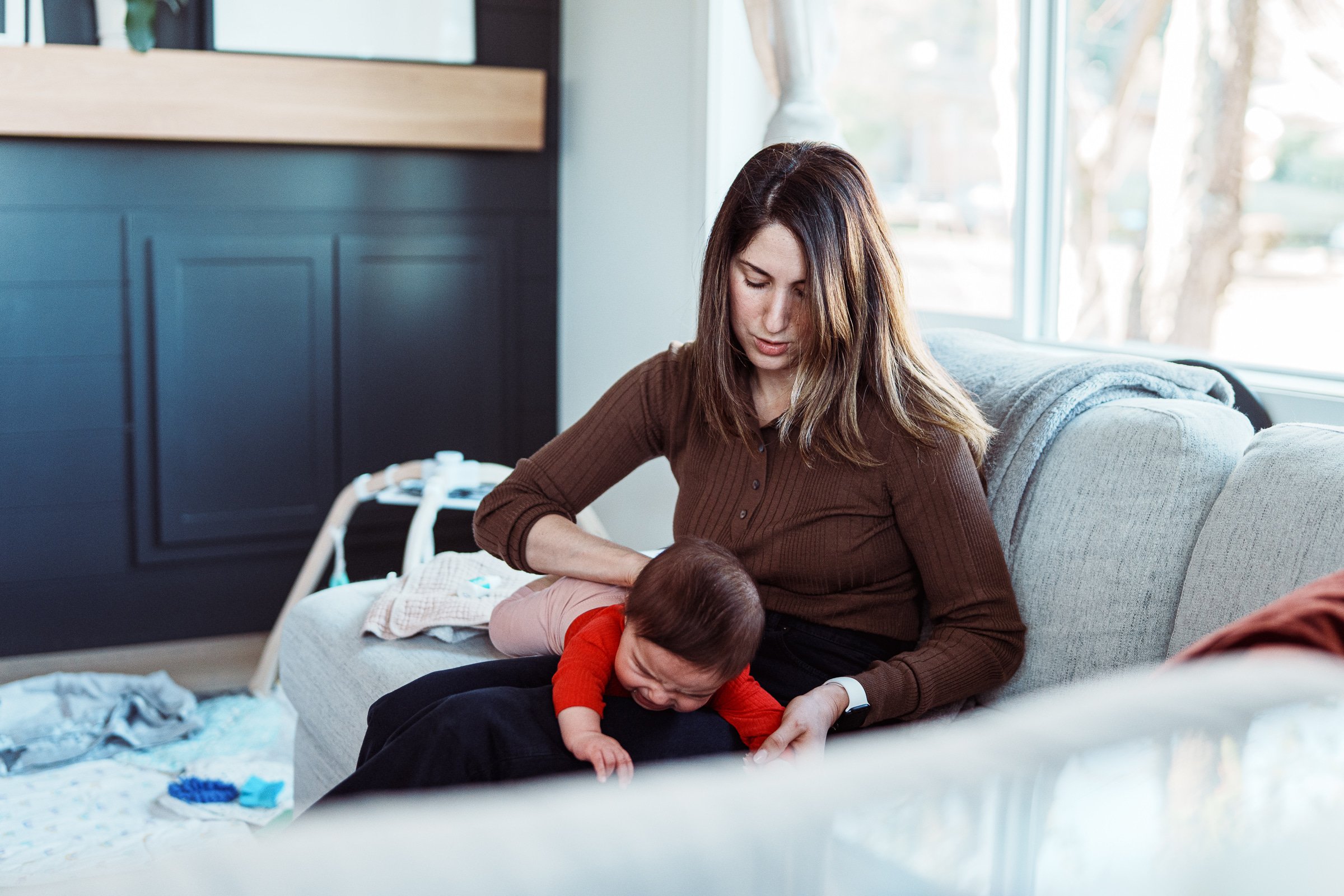
Your baby is on their tummy. They want to be somewhere else. They are making absolutely sure you know it.
Your instinct — every nerve in your body, honestly — says pick them up. Soothe them. Make it stop. And sometimes that is exactly the right call.
But sometimes? That fussing, that straining, that frustrated little grunt while they try to figure out how to move their body? That's not a problem to solve. That's development happening in real time.
This is what we call functional frustration — and understanding it might be one of the most genuinely useful things you can take away from your time with me.
What Is Functional Frustration?
Functional frustration is the productive discomfort a baby experiences when they are working at the edge of their current ability. It's the tension between what they want to do and what their body can do right now. And that gap — that motivated, effortful, sometimes noisy gap — is where motor learning actually lives.
Here's the neurological reality: when a baby works through a movement challenge, they are building neural pathways. Repetition of effortful movement — not passive movement, not being placed into position, but a baby working it out themselves — is what lays down the myelin, reinforces the motor circuits, and teaches the brain and body to coordinate. The struggle is the stimulus.
This isn't a philosophy. It's neuroscience. And it has real implications for how we support development — because our well-meaning instinct to rescue babies from frustration can, over time, actually deprive them of the very experiences their nervous system needs.
Functional frustration is not distress. It's effort. Learning to tell the difference is one of the most important parenting skills there is.
Now — and I mean this — this does not mean ignoring your baby. It doesn't mean leaving them to cry indefinitely. It means learning to read the quality of their communication, staying present and warm, and letting them work just a little longer than feels comfortable before stepping in. Your job is to be the safe base they're working from, not the crane that lifts them over every obstacle.
Let's walk through what this looks like at each major motor milestone.
Finding the Threshold: The Just-Right Challenge
Here's the thing about functional frustration: the goal is never to push your baby to the point of giving up. That's not what we're after. What we're looking for is the threshold — that sweet spot where the challenge is just hard enough to require real effort, but not so hard that the baby shuts down.
Occupational therapists and developmental specialists sometimes call this the "just right challenge." It comes from sensory integration theory, and the idea is simple: too easy, and there's no learning. Too hard, and the nervous system goes into distress and learning stops. But right at the edge of current ability — that's where the magic happens. That's where neural pathways are built, where strength develops, where confidence is born.
So how do you find it? You're watching for:
• Effort — are they straining, concentrating, working at it?
• Engagement — are they still interested and motivated, or have they checked out?
• Progress — even micro-progress, even one tiny adjustment that wasn't there a moment ago?
• Recoverable distress — are they communicating frustration but able to be briefly reassured by your voice or presence without needing to be picked up?
When you see those things, you're in the zone. When the baby goes quiet and limp, or escalates to inconsolable distress with no attempt at the task, the threshold has been crossed and it's time to offer support, a break, or a modified version of the challenge.
Finding this threshold is not a one-time calibration. It shifts every single day as your baby grows. The challenge that was just right yesterday might be too easy today — and that's the point. You're always adjusting, always reading, always moving the target forward just slightly ahead of where they are.
The goal is not to eliminate frustration. The goal is to keep it in the productive zone — where your baby is working hard, but still working.
This Is About More Than Motor Skills
I want to zoom out for a second, because what we're really talking about here is so much bigger than tummy time or crawling or walking.
When a baby works through functional frustration — when they struggle, persist, and ultimately succeed — something happens that goes beyond the physical skill they just acquired. They learn something about themselves. They learn: I tried something hard. It was uncomfortable. I kept going. And I did it.
That experience, repeated hundreds of times across the first year of life, is laying the groundwork for what researchers call a growth mindset — the belief that effort leads to growth, that challenges are opportunities, that hard things are worth attempting. Your baby isn't forming conscious thoughts about this, of course. But they are forming felt experiences. And felt experiences in infancy become the foundation for how a person relates to challenge for the rest of their life.
The baby who is always rescued before they reach their edge doesn't get to build that foundation. They don't get to discover that they can do hard things. Over time, challenge starts to feel like threat rather than opportunity — because they've never had the chance to find out what they're capable of.
The baby who is supported through the productive zone, who has a calm and confident parent nearby saying "I know, this is hard — you've got this" while they work it out? That baby is building something profound. They are learning, at the most foundational neurological level, that they are capable. That discomfort is survivable. That they can do hard things.
Learning new skills IS hard. It IS frustrating. That is not something to protect your baby from — it's something to normalize, witness, and celebrate.
And here's the beautiful reciprocal piece: every time you hold steady in the face of their frustration — every time you resist the urge to swoop in and instead stay present and regulated — you are also building something. You are building your own confidence as a parent. Your trust in your baby. Your ability to tolerate discomfort on their behalf because you know it's serving them.
Functional frustration is a gift you give your baby. And learning to hold space for it is one of the most powerful things you will do in this first year.
Now let's walk through what this looks like at each major motor milestone — what the productive zone looks like, and how to support without rescuing.
Tummy Time
What's happening developmentally
Tummy time is the foundation of everything. I mean that almost literally — the strength, proprioception, and motor control babies develop in prone position is the scaffolding for rolling, sitting, crawling, and even standing. The neck extensors, the shoulder girdle, the deep core — all of it gets built from the ground up, starting with tummy time.
And most babies hate it. At least at first.
When a newborn is placed on their tummy, their head is heavy, their muscles are immature, and the effort required to lift and hold their head against gravity is significant. Of course they fuss. They're working incredibly hard.
What functional frustration looks like here
A baby who fusses during tummy time but keeps lifting their head, turning it side to side, pushing through their forearms, scrunching and releasing — that baby is in functional frustration. They're communicating "this is hard" while their body is simultaneously figuring it out.
A baby who has completely shut down, face planted, not attempting any movement, and escalating to full distress — that baby may need a break, a position change, or some support.
The difference is effort. Is the baby still trying? Then they're in the productive zone.
How to support without rescuing
• Get on the floor with them. Your face at their level is regulating and motivating.
• Let them fuss for a few more seconds than feels comfortable. Count to ten if you have to. You will often be amazed what happens.
• Use a rolled towel or a Boppy under the chest for a slightly elevated angle if full flat prone is too hard yet — this is a bridge, not a destination.
• Short, frequent sessions are better than long, miserable ones. Two to three minutes several times a day beats one 10-minute battle.
• Tummy time on your chest counts — and it's a beautiful way to start.
When your baby fusses in tummy time, try narrating rather than rescuing: "I know, that's hard work. You're doing it. I'm right here." Your calm presence regulates their nervous system while letting them stay in the learning zone.
Rolling
What's happening developmentally
Rolling — front to back first, then back to front — is the first locomotion. It requires the baby to coordinate rotation across the midline, which is a major neurological achievement. It also requires motivation: a baby rolls because they want something they can't reach from where they are.
That motivation is essential. You cannot manufacture it for them. You can only set up the conditions.

What functional frustration looks like here
A baby who is rocking side to side, getting one arm trapped under them, grunting with effort and maybe fussing a little as they try to figure out how to get that last bit of momentum — that's the rolling learning zone. They've almost got it. Something in their nervous system is on the verge of connecting.
This is the moment parents most often jump in and roll their baby for them. I get it — it looks like they just need that one tiny nudge. But when you do it for them, you interrupt the very neural problem-solving that was about to produce the skill.
How to support without rescuing
• Place an interesting toy just out of reach to motivate the reach-and-rotate pattern.
• If they're stuck on one side with an arm trapped, you can gently reduce the surface contact under that arm — but let them do the rolling.
• Avoid rolling them for them as a "demo" over and over — passive movement doesn't build the same neural pathways as active movement.
• Make sure they have floor time on both sides and in both directions — asymmetry in rolling is common and can be addressed with positioning.
• Celebrate enthusiastically when they do it. Your reaction is part of the learning loop.
Crawling
What's happening developmentally
Crawling is one of the most neurologically complex things a baby does in the first year. Reciprocal, cross-body, coordinated movement involving both hemispheres of the brain working together, weight shifting across four points of contact, visual-motor integration, core stability — the list goes on. This is not a minor milestone. This is a full-system integration event.
And because it's so complex, the learning phase can be long, loud, and full of frustration.
Babies often go through a phase where they can see exactly where they want to go, they have the intention, and their body just isn't cooperating yet. They may push backward instead of forward (very common and very upsetting for them). They may spin in circles. They may get up on hands and knees and rock persistently without going anywhere. They are so close. And they know it.
What functional frustration looks like here
The backwards-crawling baby who is screaming because they keep moving away from the toy they want is a perfect example of functional frustration. Their nervous system is working furiously. The motor pattern is almost there. What they do not need is to be picked up and placed next to the toy.
What they need is time, floor space, and a parent who can tolerate the noise long enough to let the learning happen.
How to support without rescuing
• Give them maximum floor space. Babies learning to crawl need room to struggle, practice, and occasionally move in the wrong direction.
• Limit time in containers (bouncers, swings, walkers, jumpers) — these position babies in ways that don't support the weight-bearing and weight-shifting that crawling requires.
• Get toys that roll or slowly move away — the moving target drives problem-solving motivation.
• If a baby is consistently going backward, try placing your hands lightly behind their feet as a surface to push off of — this gives proprioceptive feedback without doing the movement for them.
• Know that skipping crawling is worth paying attention to — crawling is foundational enough that if a baby bypasses it entirely and moves straight to walking, it's worth a conversation with a pediatric PT.
Walkers and jumpers feel helpful but they actually work against crawling development. They put babies in upright positions before their core is ready and reduce the floor time where the real work happens.
Pulling to Stand
What's happening developmentally
Pulling to stand is a baby's first experience of vertical. It requires significant hip and knee strength, the ability to grade force and control the movement against gravity, and a whole new relationship with balance. When babies first start pulling up, they get there — and then they have no idea how to get back down.
This is where functional frustration becomes extremely audible.
What functional frustration looks like here
The baby who pulls to stand, is triumphant for approximately 45 seconds, and then realizes they are stuck and begins to wail — that's functional frustration. They got themselves up there. They need to learn how to get themselves down. The skill of controlled lowering (eccentric muscle control) is actually harder than the pulling up, and it's built by doing it, not by being placed back on the floor.
When a parent rushes over every time and gently lowers the baby to the floor, the baby never develops the strength or the motor pattern for independent descent. And so the cycle repeats — endlessly — because the baby never gets the chance to solve the problem.
How to support without rescuing
• Stay close and calm when they're stuck standing. Your regulated presence tells them this is survivable.
• Model the movement by bending your knees and lowering yourself. Babies are powerful observers.
• You can gently guide their hands to a lower surface to scaffold the descent — but let their legs do the work of lowering.
• Make sure the surfaces they're pulling up on are stable — a couch or a sturdy low table, not something that could tip.
• Celebrate the getting-down as much as the getting-up. Coming down safely is a major skill.
Walking
What's happening developmentally
Walking is the culmination of everything — strength, balance, motor planning, proprioception, vestibular integration, confidence, and a significant amount of sheer nerve. Babies typically take their first independent steps anywhere from 9 to 15 months, and the range is wide for a reason: there is a lot of individual variation in how all of those systems come online together.
The period right before independent walking — cruising along furniture, standing with brief hand support, taking one step and sitting down, taking two steps and falling — is one of the richest functional frustration periods of the first year.
What functional frustration looks like here
A baby who takes two steps toward you, falls, cries for five seconds, and then gets back up and tries again is doing exactly what development requires. The falls are feedback. The getting-back-up is resilience being built in real time. The frustration is the fuel.
The instinct to hold both hands and walk them around endlessly — or to put them in a push walker before they're ready — is one I see a lot. And I understand it. You want them to experience the upright movement, the joy of going somewhere. But walking with two-hand support for extended periods actually delays independent walking because it prevents babies from experiencing and integrating their own balance responses. Their vestibular system needs to feel the wobble to learn to correct for it.
How to support without rescuing
• Offer one finger instead of a whole hand — this reduces your support just enough that their balance system has to participate.
• Short distances with motivation: crouch a few feet away with arms open. Make the distance very achievable at first.
• Let them fall on safe surfaces. Falling is not failing — it's data.
• Barefoot on varied surfaces (carpet, grass, sand, hardwood) gives the feet the proprioceptive input they need to develop the intrinsic muscle strength that supports walking.
• Avoid shoes indoors — they reduce sensory feedback and make balance harder.
• Limit hand-holding walking sessions and prioritize independent exploration, even if it means more sitting down.
The baby who falls down, looks at you to read your reaction, and then decides whether to cry — that baby is using your face as a social reference for how serious this situation is. Your calm "oops, you're okay!" teaches them to self-regulate. Your panicked rush communicates that something went wrong.
A Note on Reading Your Baby
Everything I've described here requires you to develop your own ability to read your baby — and that skill takes time. You will not always get it right. You will sometimes let them work through frustration and then realize they actually needed you. You will sometimes rescue them and then wonder if you jumped in too soon.
That's okay. This isn't about perfection. It's about developing a relationship with your baby where you're genuinely curious about what they're communicating, rather than reflexively responding to every sound as an emergency.
The questions I'd encourage you to hold:
• Is my baby still trying? (If yes, they may still be in the functional frustration zone.)
• What is the quality of this communication — effortful and motivated, or escalating and distressed?
• Am I uncomfortable with their discomfort, or are they actually in distress?
• What happens if I wait ten more seconds?
That last one is my favorite. Wait ten seconds. You will be amazed how often your baby answers their own question.
Development is not a performance. It's a process. And some of the most important moments in that process look a lot like struggle.
Your baby doesn't need you to clear every obstacle. They need you to be present and steady while they work through it — to find that just-right threshold and hold it with them. That's the thing that builds motor skills and confidence and resilience. It builds a child who knows, deep in their bones, that they can do hard things.
And it starts with tummy time. It starts with you, on the floor, counting to ten.
Love, Emily
This post is for educational purposes only. If you have concerns about your baby's motor development or feel that frustration is consistently escalating beyond what feels manageable, please reach out to a pediatric physical therapist for an individualized evaluation.
Want more support understanding your baby's development month by month? Explore the Beyond Birth Blueprint or connect with our team at bewellbaby.org.