The Breast Crawl
TLDR: This is a super powerful instinct, and there is a video of a very typical looking (and kinda boring) breast crawl in the middle of this blog.
The breast crawl is one of the most remarkable things a human body does. It's the first time that a baby humans reflexes and motor system has to coordinate for an activity. And if you ask me, it’s the most fascinating and beautiful parts of meeting your baby for the first time. It's also a documented, filmed, studied instinctive sequence that healthy newborns move through on their own, given the chance and given time.
I love this research because it says something I believe deeply in my work with families: babies aren't broken. Their bodies come loaded with reflexes and timing that work, often better than our hospital routines give them credit for. And often, we a just getting in the way. Knowing the stages helps everyone in the room, parents, nurses, doulas, partners, know what they're watching and why patience is the intervention.
Where the research comes from
Much of what we know about the breast crawl traces back to Swedish researcher Ann-Marie Widström and her colleagues at the Karolinska Institutet, who filmed newborns immediately after birth and coded their behavior second by second. A related 1990 study by Righard and Alade compared babies who stayed skin to skin with their mothers uninterrupted for at least an hour to babies who were separated for about 20 minutes for routine measuring and dressing. The uninterrupted babies weren't just calmer. Days later, at discharge, they were far more likely to have a correct, deep latch than the babies who'd been briefly separated right after birth.
That's the headline finding underneath all of this: a short, well-meaning interruption in the first hour can shape sucking technique days later. The body is doing something important in that window, and it notices when it gets cut off.
The nine stages
Widström and colleagues described nine distinct, observable phases a newborn moves through when placed skin to skin and left undisturbed. They don't happen instantly, and they're not always linear or tidy, but the sequence holds up across cultures and studies:
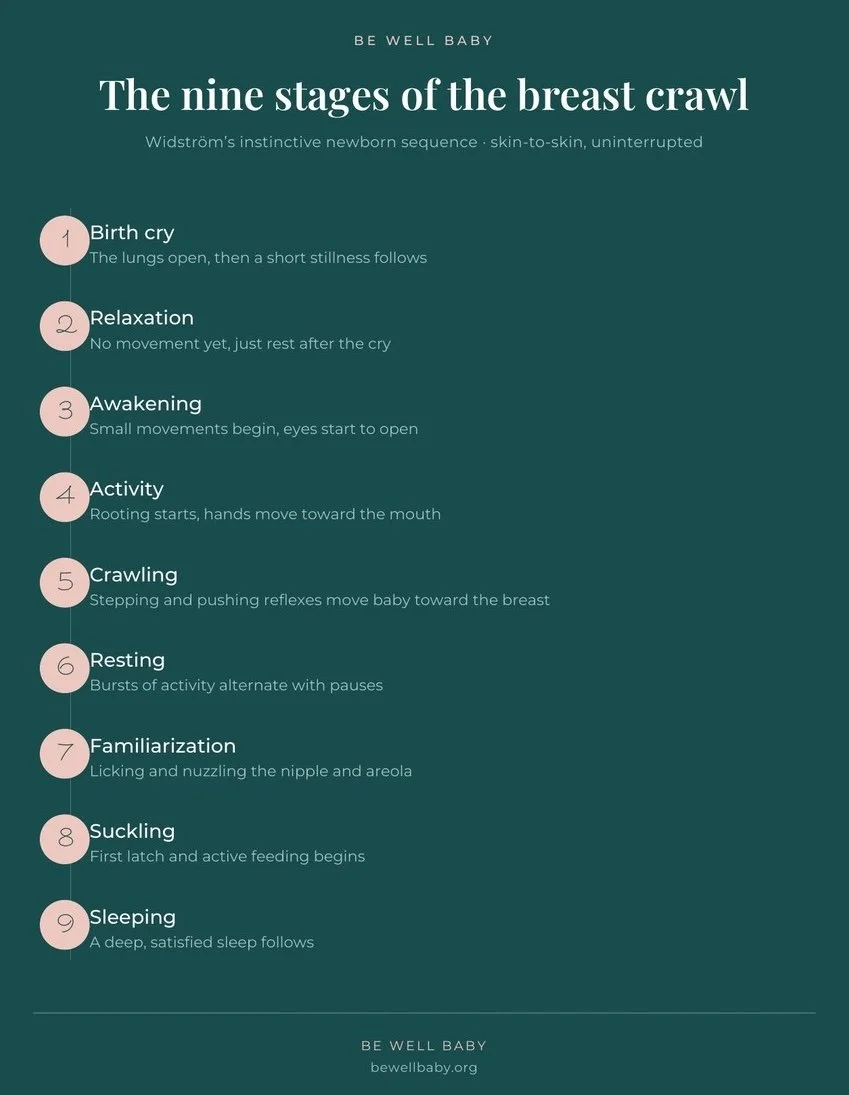
Why the golden hour matters
You've probably heard the phrase "golden hour" used for that first hour after birth. It's not just a warm, feel-good phrase, it describes a physiologically distinct window. During uninterrupted skin-to-skin contact in this period, a newborn's heart rate, temperature, and blood sugar stabilize more effectively than under a warmer. Maternal oxytocin rises, which supports bonding, milk-ejection, and even placental delivery. And the baby, if left undisturbed, has the best physiological conditions to move through the nine stages and reach an effective first latch on their own terms.
The World Health Organization and UNICEF's Baby-Friendly Hospital Initiative built this directly into Step 4 of their global standards: facilitate immediate and uninterrupted skin-to-skin contact and support self-attachment, rather than a staff-directed or "hands-on" latch.
There's also a mortality dimension that doesn't get talked about enough. Research reviewing breastfeeding initiation timing found infants who first breastfed 2 to 23 hours after birth had a meaningfully higher risk of neonatal mortality, and infants whose first breastfeed was delayed 24 hours or more had more than double the risk, compared with infants who breastfed within that first hour. The golden hour isn't precious in a sentimental sense only. It's protective.
So how long does the first latch actually take?
This is the part parents (and honestly, a lot of clinicians) are surprised by. When newborns are left skin to skin and uninterrupted:
Crawling movements toward the breast typically begin somewhere around 20 to 30 minutes after birth.
Across a multi-country comparison of Widström's nine-stage data, the time from birth to the start of crawling ranged from about 18 to 54 minutes, with real cultural and hospital-practice variation. Interestingly, in that same comparison, only about 15% of babies in one country's cohort reached the crawling stage at all, compared with over half in another, a difference researchers attributed largely to how much staff intervened.
Effective suckling, the actual first latch and feed, tends to begin somewhere around 50 to 60 minutes after birth, though it can reasonably take up to two hours. That's a full hour of instinctive, unhurried work before that first feed even starts, and it's completely normal.
None of this is fast by hospital-clock standards. And that's exactly the point. A baby who takes 45 minutes to get to the breast isn't behind. They're doing stage six of nine.
What this means in practice
I think about this constantly with the families I work with, especially NICU grads and babies who've had a complicated start, because the golden hour isn't always available to them the way it is to a healthy term baby delivered vaginally with no complications. That's real, and it's a loss worth naming. But the underlying principle still applies wherever and whenever skin-to-skin becomes possible: babies do better with time, with contact, and with as little interference as we can manage. Whether that first uninterrupted skin-to-skin window happens at one hour of life or one week of life, the same instinctive sequence is still in there, waiting for the conditions to unfold.
If you're preparing for birth, this is worth putting in your birth preferences in plain language: uninterrupted skin-to-skin immediately after birth, delay routine measuring and procedures until after the first feed when medically appropriate, and let the baby lead the latch rather than having staff place the baby on the breast for them. If you've already had a birth where this didn't happen the way you hoped, know that self-attachment and effective latch are still absolutely achievable outside that first hour. The window doesn't slam shut. It just becomes a longer road to the same instinctive place.
References:
Widström AM, et al. "Newborn behaviour to locate the breast when skin-to-skin: a possible method for enabling early self-regulation." Acta Paediatrica, 2011.
Righard L, Alade MO. "Effect of delivery room routines on success of first breast-feed." Lancet, 1990.
Brimdyr K, et al. "The nine stages of skin-to-skin: practical guidelines and insights from four countries."
Maternal & Child Nutrition, 2020. Widström AM, et al. "Skin-to-skin contact the first hour after birth, underlying implications and clinical practice." Acta Paediatrica, 2019.